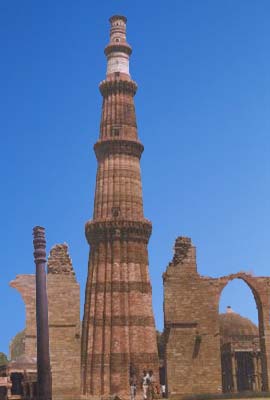
Qutb Minar
Construction commenced in the year 1193 for this 73 meter high victory tower by Qutab-ud-din Aibak (the first Muslim leader of Delhi) right after the last Hindu kingdom of Delhi was wiped off after their defeat in war.
Qutb Minar is the tallest brick minaret in the world and a great example of Indo-Islamic architecture. Qutb Minar is housed in the Qutb complex of South Delhi and has been declared as a world heritage site by the UNESCO. The tower has 399 steps in all to climb to the highest point of the tower. Tourists are allowed only till the first floor of the Qutb Minar due to security reasons.
Qutab-ud-din Aibak was able to complete only the basement of this structure and Iltutmush added on three more stories to the Qutb Minar in the year 1368. The last and the fifth storey to the Qutb Minar were added on by Firuz Shah Tughluq.
The Qutb minar is built on the ruins of Lal kot, the Red fortress of Dhillika, the capital of the very last Hindu rulers of Delhi. In 1803 an earthquake damaged this tower and it was repaired in 1829 by British Major Robert Smith.
Qutb Minar
- Each of the five storeys of the Qutb Minar has a balcony of its own and this narrows starting with a 15m diameter at the base to a mere 2.5m diameter at the top. The first three storeys are made from red color sandstone, the fourth and fifth floor are built of marble and sandstone. The mosque though now in ruins, is still the most magnificent mosques of the world.
- Quwwat-ul-Islam mosque is situated at the basement of the tower and is the first ever mosque to be built in India. An iron pillar measuring to a height of 7m is positioned in the courtyard of the mosque.
- The eastern gate carries an inscription quoting the fact that 27 Hindu and Jain temples were destroyed and that material was reused for constructing the Qutb Minar. The ornamentations in the mosque are all the ones that were used in the destroyed Hindu temples and thus the mosque bears the resemblance to Hindu ornamentation in its interiors.
- The tower is erected in a way that the shadow is cast on both the east and the west side and it is believed that the shadow of god is cast along with the shadow of the tower. This has been inscribed in the language of Kupee in the Qutb and also the Aayaat from the Quran is also inscribed here.
Visiting Qutb Minar
Delhi is well connected to the rest of India and the world and can be reached easily by air, rail or road. Within the city there are buses, private taxis and auto rickshaws that can take you around. Qutb Minar is open from sunrise to sunset on all weekdays and they charge an entrance fee of Rs.10/- from people aged above 15years. Climate is warm during summers and cold during winter. The blossom season is February and March and the whole of Delhi is green and beautiful to watch.
|